Peyton Lambourne. I build AI systems.Now I’m asking what they’re for.
I’m Peyton Lambourne, 23, a barista in West Jordan, Utah. On my own time I build AI tools, red-team the models underneath them, and write about what it all adds up to.
Fig. 1 The Lorenz attractorThree equations from a 1963 weather model, and where the phrase “butterfly effect” comes from.
How to read the figure
Why there’s a butterfly on this page
It’s the Lorenz attractor: three short equations Edward Lorenz wrote in 1963 to model the weather, and the reason we say “butterfly effect”. It’s also the clearest picture I know of the problem I work on.

01
Nearly the same start
Two lines begin 0.00001 apart and follow exactly the same rules. For a long while you can’t tell them apart.

02
A completely different path
Then the gap doubles, and keeps doubling, until they’re on different wings. Nothing random happened. A difference too small to see grew until it decided everything.

03
Always the same shape
Neither line ever leaves the butterfly. You can’t say where a line will be next, but you can know the shape it stays inside.
What this has to do with AI
Language models behave a lot like this. Change three words in a prompt and a model that refused will comply. Hide one sentence in a document and an agent will follow it. You can’t test every input, so you can’t predict every answer.
What you can do is push on a system deliberately, thousands of small nudges, and map the shape of what it does, including the parts nobody wanted. That’s red-teaming. It’s what Adversec does, and it’s why this site is about safety.
Reading the live figure
- Blue
- Your line. Pick where it starts on the figure at the top.
- Red
- A copy of your line, moved 0.00001. It shows up as you scroll.
- Grey
- My line. Same rules, started at t = 0.
- t, δ
- How far along the lines are, and how far apart yours and its copy are. Both update as you scroll.
What I pay attention to
In order. Safety is first on purpose.
Fig. 2 Sensitive dependenceTwo copies of the same line, 0.00001 apart, look like one line for a long time.
- AI safety
- Whether a system does what we meant, and what happens when it doesn't.
- AI security
- Prompt injection and data leakage are bugs. I treat them like bugs.
- Red teaming
- Attacking a model on purpose, so the failure shows up in a test instead of in front of a user.
- Open-source AI
- Open weights put frontier capability on a laptop. That's the promise and the problem at the same time.
- that tension is most of log.017
- Agents
- Systems that plan and act on their own. More useful, and harder to oversee.
- Evals
- If you can't measure a failure, you can't say you fixed it.
- Local models
- What runs on hardware you own, and what that changes about who's in control.
- Interfaces
- The shortest path between a person and a model, and what that path hides.
Things I’ve built
Three products. Two are live; one I’m shutting down, and the case study says why.
Fig. 3 DeterministicEvery step is exact arithmetic. That doesn’t make it predictable.



Small inputs, large consequences.
Move three words in a prompt and a model that refused will comply. Hide one instruction in a document and an agent will follow it. It’s the same failure every time: a tiny change to the input, a large change to the output.
Adversec is the tool I built to look for those changes on purpose. Point it at an LLM endpoint and it runs prompt-injection, jailbreak and data-leakage probes, then reports what broke and why. I started it as security work. It’s the reason I now think of security as safety work.
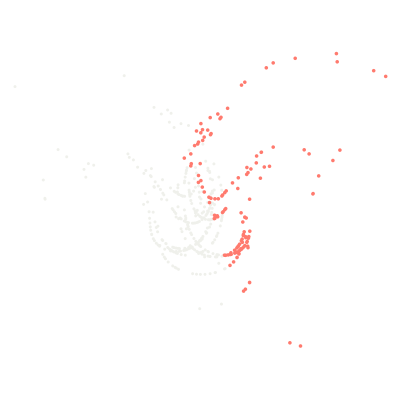
Fig. 4 Small inputs480 starting points, each within 0.001 of the others, run through the same equations. The red ones ended up on the other wing: 143 of them.
Logs
Seventeen so far. The recent ones are about models that improve themselves, the memory AI is eating, and the lock-in problem.
Fig. 5 DivergenceThen they come apart, and never agree again.
- log.0177 minthe lock-in problemToby Ord calls it an unrecoverable dystopia: humanity survives but never escapes. A 19-minute video walks through how AI censorship, mind-reading research, and even well-meaning AI safety regulation could get us there. The scary part isn't the tyrant. It's that the tools built to stop catastrophes are the same ones a tyrant would need.7 min
- log.01612 minthe memory eatersAI data centers now consume 70% of global memory output. Console prices have doubled, studios are closing, and games that will never be announced are being killed at the pitch stage. All because of RAM. Meanwhile China, locked out of the memory boom by US export controls, is building cheaper models and a domestic chip supply chain. The United States is cannibalizing its own consumer economy to feed an arms race it might not win.12 min
- log.0159 minthe missing questionOpen source just caught the frontier and KV cache compression keeps breaking the memory wall. The next milestone isn't a smarter model — it's a curious one. Recursive self-improvement won't come from better answers. It'll come from a machine learning to ask questions. That's also what makes it dangerous.9 min
How I got here
No CS degree yet. Most of what I know I learned by building something and then finding out where it breaks.
Fig. 6 Strange attractorNeither line repeats, neither settles, and neither leaves this shape.
- Before 2025Taught myself to code with Minecraft chat bots, then taught myself machine learning.
- 2024–2025Built WrapsRL. It made $600 in its first month. I’m shutting it down now.
- 2025Finished the University of Utah's machine learning bootcamp.
- 2025Shipped CanIRunAI and Adversec.
- 2026Earned BlueDot Impact’s Future of AI certification.
- Sept 2026One year behind the counter at Starbucks.
- Fall 2026Starting at ASU Online through the Starbucks College Achievement Plan. First classes: MAT 114 and CIS 105.you are here
Write to me.
Hiring for safety, evals or red-teaming? Building with open models? Read a log and think I got it wrong? All good reasons to email.
hi@peytonlambourne.com
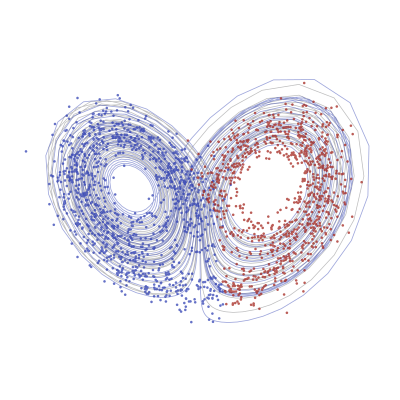
Fig. 7 The butterflyTwo lines, all the way to t = 44, and 2,000 copies of the blue one, let go from where it stopped: blue on that wing, red on the other. Different paths, the same shape.