CanIRunAI
Match open-source LLMs to the hardware you own.
- Status
- Live
- Years
- 2025
- Built with
- Next.js, TypeScript, Supabase, Python, Claude Haiku, GitHub Actions
- Live at
- canirunai.vercel.app
- 1,284+
- open models tracked, with quantised variants
- VRAM-aware
- scoring against your exact GPU, or CPU and RAM
- Weekly
- automatic ingestion from Hugging Face
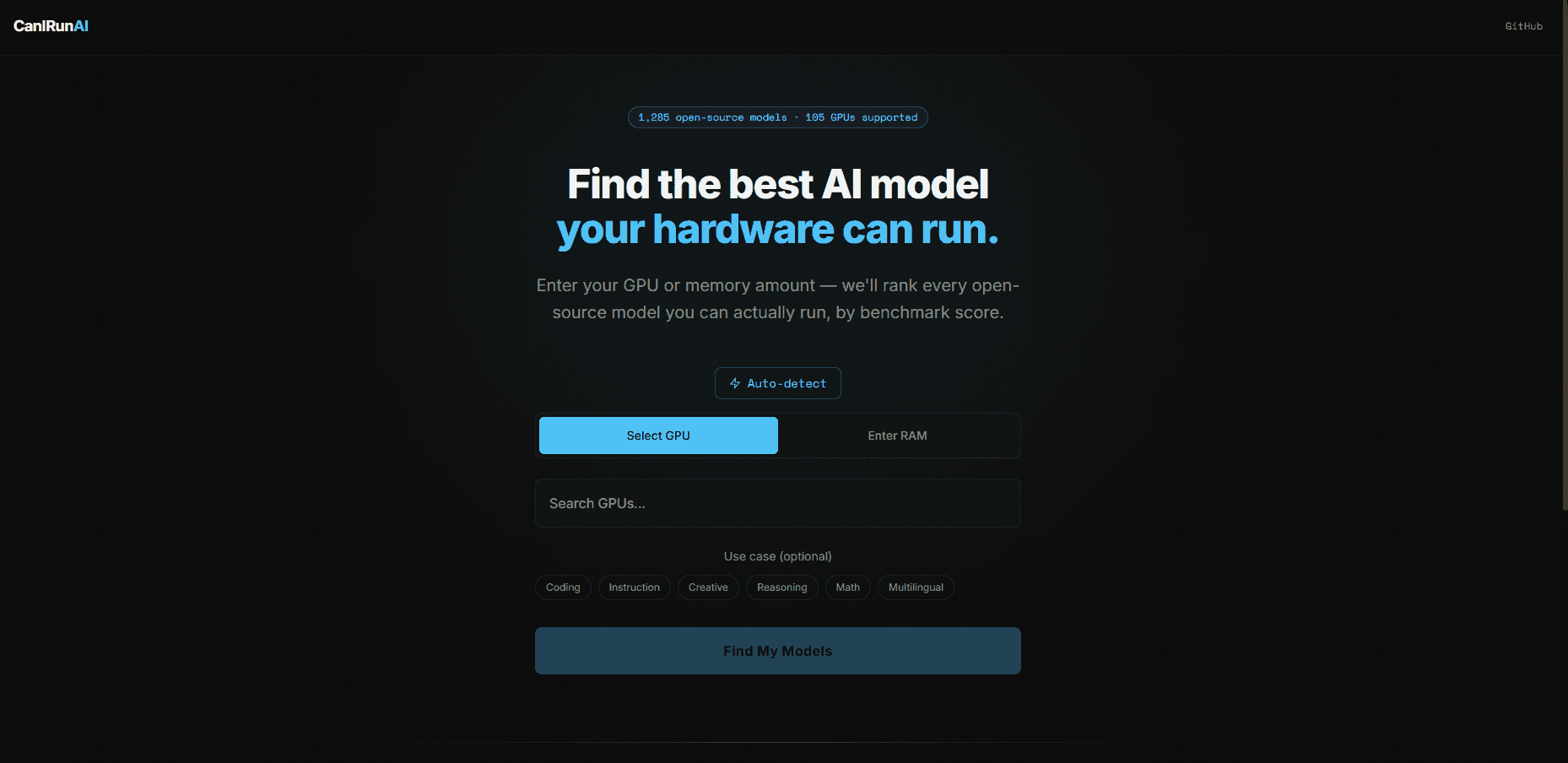
If you've tried to run a local model, you know the question: will this even fit on my machine? CanIRunAI answers it in a couple of seconds.
The problem
There are thousands of open-source LLMs, each with dozens of quantised variants. Working out which one fits a specific GPU, or a CPU and RAM combination, meant reading spec sheets, cross-referencing VRAM requirements and losing an hour on Hugging Face.
The approach
CanIRunAI indexes the open-model ecosystem, tracks quant variants from GGUF to AWQ, and scores each model against your hardware. Pick your GPU, or let it detect one, and you get a ranked list of models that will run, with honest speed estimates and quality trade-offs.
The ingestion pipeline
The part I'm proudest of is freshness. A Python scraper runs weekly on GitHub Actions, pulls new releases from Hugging Face, parses configs, extracts quant variants and writes them to Supabase. Claude Haiku sits in the middle normalising messy model cards, because every one is formatted differently. The index stays current with no manual work.
Why it's on a safety site
Open weights are the most democratic thing in AI and one of the hardest to govern. A tool that makes it easier to run capable models locally sits right on that line. I built it because I believe people should be able to run these models on hardware they own. I also write about what that means when the models get stronger.
What's next
v2 is in progress: wider model coverage, finer hardware profiles (Apple Silicon unified memory is its own problem), and a side-by-side view for comparing two models before you download either.
- Llama
- 340
- Qwen
- 210
- Mistral
- 185
- Gemma
- 95
- Phi
- 62
- Other
- 392
Where it is
Live, used, and growing. The ingestion means the index improves whether or not I touch the code that week, which is the property I want from a tool like this.